Glossary and Abbreviations
by Richard Dieterle
 1/8 — spoken as "First of the Eighth." First Battalion, Eighth Cavalry, a battalion of the First Brigade of the First Air Cavalry Division. The First Brigade was originally Airborne, but this status was phased out in 1967 as part of the conversion of the division to air mobile status. The First Brigade also contained two other battalions: 2/8 and 1/12. The Eighth Cavalry was a regiment, and by this time regiments had been phased out of the army organization system, being replaced by the battalions. However, the regiment was always the unit of sentiment and its traditions live on in the battalions that still carry its name. The Eighth Cavalry was formed in 1868 in connection with the Indian Wars. Its emblem was a rearing white horse with the slogan "Honour and Courage." The First of the Eighth was the unit to which the authors of this website belonged.
1/12 — spoken as "First of the Twelfth." First Battalion, Twelfth Cavalry, a battalion of the First Brigade of the First Air Cavalry Division. Along with the 1/8 and the 2/8, it made up the First Brigade.
1 ACD — 1st Air Cavalry Division.
I Corps — pronounced, "EYE core." This stood for the First Corps, a rather artificial unit composed of Divisions. However, in practice, it represented a division of the country into sectors that formed natural areas of operation from the standpoint of the US military. The was done for all of Indochina, as can be seen on this map. The First Corps area was located from the DMZ on the North Vietnamese border, down past Đà Nẵng in the south. I Corps roughly corresponded to Quảng Trị Provence. Đà Nẵng, on the coast, was the "capital" of the I Corps, so to speak. The I Corps was the AO of the Marines and the 101st Airborne Division. The Cav later entered this area on a special mission to relieve Khe Sanh. As the northernmost sector of South Vietnam, it represented the most dangerous area and the place where the NVA operated with the greatest strength.
I FFV – I Field Force, Vietnam. This was a command whose responsibility was II Corps Tactical Zone, made up of the 12 provinces of the Central Highlands. It was activiated 15 March 1966. See the maps:
South Vietnam, Provinces and Corps Areas; Indochina, Military Regions.
11B (11 Bravo) — the military occupational specialty (MOS) code for infantry.
16 (one-six) element
— the designation for the platoon leader (lieutenant) of the first platoon of a company, and derivatively for that platoon. The second platoon was designated 26 (two-six), and so on. The designation 15 is for the platoon sergeant. Next in rank is 14, the leader of the fourth squad (the weapons squad). The four squads can therefore be denoted in order by 11, 12, 13, and 14.
 173rd Airborne Brigade — an airborne brigade whose most notable battle was at Dak To in 1967. For much of the period covered on this site, the 173rd shared LZ English with the Cav.
27 Mike ("Two-Seven Mike") — an artillery forward observer attached to field infantry units. His job was to call in artillery for the support of the infantry unit to which he was attached. He carried his own radio and might function as a radio operator for an officer who was a forward observer. But as often as not, he alone called in the artillery and did a good job of it. Usually the first round was smoke, then he would tell the artillery with whom he was in communication via radio how they should adjust their fire before they fired for effect (opened up with everything they had).
2/8 — spoken as "Second of the Eighth." Second Battalion, Eighth Cavalry, a battalion of the First Air Cavalry Division. Along with the 1/8 and the 1/12, it made up the First Brigade.

.45 automatic pistol — a single-action, semi-automatic, magazine-fed, recoil-operated pistol that fires a .45 caliber round, with the military designation of M1911. It was typically carried by some officers, medics, and machine gunners.


.50 caliber machine gun — the Browning M2 Machine Gun was invented by John M. Browning in 1917 and was still in use during the Vietnam War. The weapon is air-cooled, and can fire 450-575 rounds per minute. The gun weighs 84 pounds (38 kg) and its M3 tripod another 44 pounds (20 kg). It employs a V-shaped "butterfly" trigger housed within a "spade handle" hand-grip located at the rear of the weapon. The round is shown actual size.
79'er — someone whose primary weapon was an M-79 grenade launcher, as opposed to a rifleman or gunner. See the piece on the "Mad 79'er."
A 1/8 — spoken as "A [company] first of the eighth." A[alpha] Company, First Battalion, Eighth Cavalry. See 1/8, and First Air Cavalry Division. This is the unit to which the authors belonged.
AB — air base.
AFRN — the American Forces Radio Network is a government radio broadcast service the U.S. military provides to those stationed or assigned overseas.
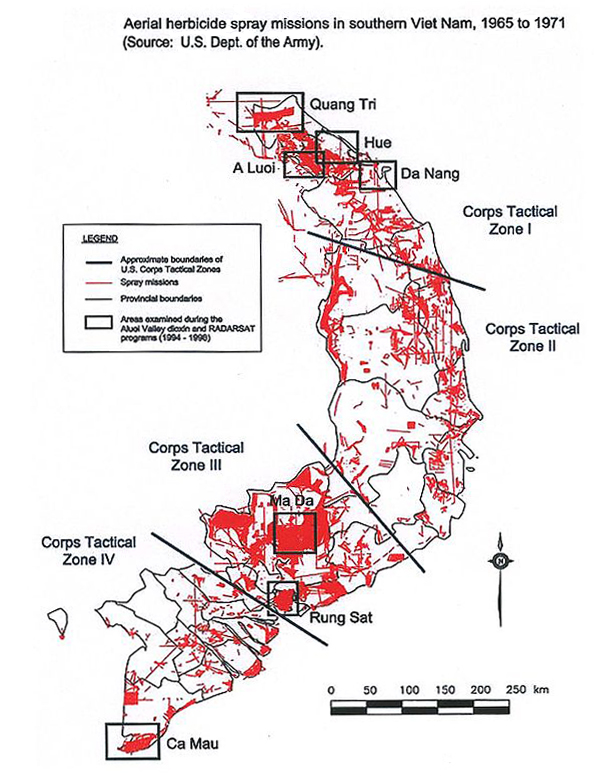
Agent Orange — a chemical defoliant (leaf remover) usually applied by air, designed to remove the jungle foliage used by the enemy for concealment. It proved to be a very potent poison, killing not only plants, but eventually most of the people who were over-exposed to it. The government denied that there were any negative health effects caused by working with Agent Orange, but were finally, many years later, forced to concede the full danger associated with this chemical. Many people died as a result of this delay in treatment. See Jerry Prater's, "Why Am I Still in the Army?" The poison was so powerful that it not only caused the vegetation to loose its leaves, but actually killed whole forests of trees. See, "The Dead Forrest." For a map, see Agent Orange Spray Missions. The photo below shows C-123s spraying Agent Orange over a tract of jungle.

airborne — jump qualified. An airborne unit consists of paratroopers, whose primary means of entering battle is by parachute. The use of parachutes in Vietnam was rare to the point of being almost non-existent. The 101st, the 173rd, and the 1st Brigade of the Cav, were airborne.
air mobile — a designation for any unit whose operations were highly integrated with its helicopter arm. Originally, only the First Air Cavalry Division was air mobile, but later the 101st Airborne also became air mobile. In practice this meant that infantry units were moved around by helicopter to locations where they would begin "humping the boonies." During firefights, air mobile units would receive a great deal of ARA gunship support.
AIT — Advanced individual training. It was a more advanced training held after basic training. At AIT we acquired our MOS and spent time gaining competence in our field. A great deal of time was spent on marksmanship with the M-16. The AIT of both Dieterle and Prater was done at Ft. Polk, Louisiana, in training units known respectively as D-3-3 and E-3-3.
AK-47 — the standard automatic rifle used by the Red Army and its allies, including the Chinese. Also known as a "Kalashnikov" after its inventer, although in the Nam it was always referred to as an "AK-47." It used 7.62 ammunition, and had a selector switch that enabled it to fire either on semi-automatic or fully automatic. It had a wooden stock and a good reputation for accuracy and reliability, although it was a bit heavier than an M-16 and its larger ammo was also more cumbersome to carry.

alert — a condition of advanced readiness. In practice alerts were only declared at night when it was believed that there was a likely chance for an enemy attack. A 100% alert is therefore a condition under which everyone pulls guard and no one sleeps. In a 50% alert, half the men sleep while the other half pull guard. The normal situation was for one man to pull guard while the rest of the men at his location slept.
AN/PRC-25 Radio — the standard radio carried on the back of the RTO. It was powered by a battery which was fastened to the bottom of the unit with metal clips. The whole composite weighed 23.5 pounds.

AO — area of operation, that is, where a unit typically worked and where it had its base camp or forward LZ.
APC — Armored Personnel Carriers. They resemble landing craft, but have a covered armor top with one .50 caliber machine gun mounted in the center, and by the rear corners, two M-60 machine guns. Then men who travel inside are protected against small arms fire and shrapnel, but .50 caliber rounds can pierce its armor, as well as most rockets. The photo below shows APCs in Vietnam with infantry trailing behind them.

ARA — aerial rocket artillery, a Huey or Cobra helicopter gunship with rocket pods capable of firing six rockets attached to each side of the chopper.
Ares — the Greek god of war, the counterpart of the Latin Mars.
Artillery Liaison Officer — an officer responsible for calling in artillery in support of an infantry unit. "The artillery liaison officer with the infantry front line unit must be ... an experienced artilleryman. That is, he must know the capabilities and limitations of his arm. He must be able to adjust the fire of the batteries of his battalion and other batteries quickly when necessary. He must be an officer possessing force and initiative and should be tactful. An artillery commander assigned to support an infantry unit should establish his Command Post with, or in the immediate vicinity of, that of the commander of the infantry unit supported, if it is at all possible to properly command his organization and direct its fire from that point." Major Elmer Yeager, "Supporting Artillery," Infantry Journal, 19, #3 (Sept., 1921): 307-311 [308-309].
ARVN — (pronounced "AR vin"). Army of the Republic of Vietnam or its soldiers. This was the regular army of South Vietnam.
B-40 — a medium size rocket similar to a grenade in explosive power. Originally manufactured by the Soviet Union as RPG-2. These were also manufactured in North Vietnam and were used extensively by the NVA, as shown in the photograph below from 1968.

B-52 — as far back as 1945, Air Materiel Command requested a new bomber "capable of carrying out the strategic mission without dependence upon advanced and intermediate bases controlled by other countries." This bomber eventually evolved into the B-52 Stratofortress. The first of these aircraft were rolled out on 18 March 1954. The bomber has a crew of five, six counting the tail gunner of older models. It has a length of 159 ft 4 in (48.5 m), and a wingspan of 185 ft 0 in (56.4 m). Its weight when empty is185,000 lbs., and when fully loaded, 265,000 lbs. Its maximum speed is 650 mph. Its service ceiling is 50,000 ft., and it has a range of 4,480 miles.

baby-san— a child or an unmarried woman of any age. From Japanese pidgin English.
base camp — the headquarters of a division. It was like a giant LZ. The base camp of the Cav was An Khê, in the Central Highlands. Anyone assigned to the Cav would enter or leave the country through An Khê. For maps showing An Khê, see: An Khê and Vicinity, An Khê (Camp Radcliff), Detailed.
battalion (btn) — a unit composed of companies. It usually had one company back at a rear area to guard the LZ or base camp, and four line companies (Alpha, Bravo, Charlie, Delta) in the field, although at any one time, usually one of these was given duty at a forward LZ guarding its perimeter or actually building an LZ. Battalions were grouped together to form brigades.
betel nut — the name given to what was chewed for stimulation mainly by old people. It is a misnomer, since it is the leaves that are psychoactive. The leaf of the Piper betle plant is typically wrapped around an areca nut and the two of them are chewed together. The resultant juice is red, but it tends to turn the teeth black.
Big Red One — The First Infantry Division, so called from its patch, which was olive drab with a large red numeral "1" in it. Last word in "Big Red One" was slightly accented. It operated in the Mekong Delta in the Saigon area.
"bit" or biêt— 'know'. Pronounced, byet, but we pronounced it, bit, bick. Most frequently used in the pidgin expression, no byet, "I don't understand."
black pajamas – the thin, silky, black cloth from which the typical peasant's shirt and trousers were made, and the simplicity of their design, made them look just like Western pajamas. They were actually working clothes, especially in the countryside.
 |
| Vietnamese Black "Pajamas" |
blue line — a stream or river, from its standard representation on a map as a blue line.
booby traps — small traps usually activated by a trip wire that were designed to inflict injury upon enemy troops. Primitive booby traps, which were rarely seen during my tour of duty, could be contraptions made of spikes of various sorts. Most booby traps were hand grenades attached to trip wires that were strung across pathways. A person striking the trip wire would pull the pin out of the grenade to which it was attached, causing it to explode from its concealed position. Artillery shells could be buried and a pressure plate devise put on the cone of the projectile so that anyone stepping on the plate would set off the shell. See also, "bouncing Betty," and "butterfly mine."
boom-boom — a pidgin term for sexual intercourse.
boonies — boondocks, a remote wild area.
bought the farm — killed. An old expression, apparently from the $10,000 compensation paid to the family of anyone killed in action (e.g., to look on the bright side, it was enough to buy the family farm in WWI. Signed into law by Woodrow Wilson.)
Bouncing Betty — a land mine mounted with a pressure sensitive device. Releasing pressure on this device would cause the mine, buried just below the surface, to spring up to about chest height and explode.
Brass — high ranking officers, particularly those of field grade (full colonel and up).
brigade (bde) — a large unit making up a division, and itself made up of battalions. Usually, three battalions made a brigade, which fell under the authority of a brigadier general as a rule. The authors were in the First Brigade of the First Air Cavalry Division.

United States Army, Army Heritage Museum B.A.R.
Browning Automatic Rifle (BAR) — in effect, a light machine gun firing a .30-06 cartridge from a rifle magazine. It was in service from WWI through Vietnam.
Buck Sergeant — a Sergeant E-5, one rank above Spec-4 and Corporal. It was indicated by three stripes on the uniform as shown in the illustration. In the infantry, the Buck Sergeant generally commanded a squad. The next rank up, Staff Sergeant (E-6), was represented by the three stripes of the Buck Sergeant plus a rocker below as the fourth stripe.
bucu, boocoo— "very, much, many, a lot (of)." Pidgin French, from beaucoup, of similar meaning. Usage: "you bucu dinky-dau"; "you bucu numbah ten"; "we killed bucu of the enemy in the last firefight."
bug juice — a slang term for military issue insect repellent. It was highly effective in repelling ants and, to a lesser degree, mosquitoes. Its most important function was as a lubricant for the chamber of an M-16, since the grease in it seemed to prevent carbon build up. Bug juice bottles, which were small plastic bottles about the size and shape of nasal decongestant bottles, were stored in the camouflage band of the soldier's steel pot (helmet).

bunkers — in Vietnam, a bunker was a defensive structure typically 10 feet square constructed out of sandbags. It had a slit window facing to the front and either a single entryway in the back, or two side entry ways. It was always partly below ground and had a roof of sandbags mounted over metal runway slats. Most bunkers had a small shield of sandbags on the top front so that someone could pull guard from that vantage point without being unduly exposed. A bunker usually housed four or five people, about half a squad. The photo below shows a typical bunker from 1967 at LZ Two Bits.

butterfly mine — the PFM-1, a mine of Soviet manufacture. The whole mine functions as a pressure plate device. When pressure is put on the mine itself, it explodes with sufficient force to remove a foot. It is rarely lethal.
 |
| A Butterfly Mine |
C-4 — a plastique (plas TEEK), or plastic, explosive. At the time the French plastique was more common, but it has now been superseded by "plastic." It was a white substance which could be molded like modeling clay and was detonated by an electrical charge. It was the explosive used in a claymore mine, otherwise it came in bars like the one shown below. C-4 was also used, without the army's permission, as a fuel for heating C rations.

A. I. Explosives
C-7 Caribou — manufactured by De Havilland Canada, and first flown in 1958, it is often described as a "rugged work horse." The Caribou was designed as a "bush plane," capable of taking off and landing on short runways. This proved to be a vital feature in Vietnam, where many airstrips were degraded or designed for small aircraft.
C-123 Provider — the basic transport plane used in the Vietnam War. It was originally acquired by the US Air Force in 1953, but the C-123K was generally flown by the Army. Besides transport duties, the plane was also used in Agent Orange defoliation efforts.
 |
|
 |
|
 |
| C-123K Provider over Vietnam |
|
C-130E Hercules |
|
C-7 Caribou |
C-130 Hercules — created during the Korean War, it represents a heavy duty counterpart of the C-123. It is designed for both cargo and troop transportation. Some C-130s were converted into gunships. See Guns à Go-Go.
C/A – combat assault. This is a helicopter assault into an unsecured area where there is at least the possibility of an enemy presence.
C rations — army issue food for use in the field. A unit came in a cardboard box containing cans of food, a small can opener, plastic utensils, and toilet paper. The contents of a C rations box from 1966 are shown below, with a P-38 can opener resting on the last can to the right. The beans and franks in the opened central can were generally acknowledged as the best meal that these rations could offer.

cartridge (round or shell) — a type of ammunition that consists of a bullet affixed to a case (usually of brass), containing gunpowder, with a primer at its base, which fits exactly within the firing chamber of a firearm. Several calibers are shown below.

From left to right: 7.62 and 5.56 caliber cartridges compared for size with a AA battery. The 7.62 ammo was used by the enemy's AK-47 rifle (as well as our own M-14 and M-60), whereas the 5.56 was used by our M-16.
The Cav — The First Air Cavalry Division, Air Mobile. (For an image of its division patch, click here).
CD – civil defendants. "The 1st MIT interrogation section in Vietnam was often swamped with Vietnamese rural villagers who were dragnetted by infantry units on their sweeps of the countryside and delivered to the brigade base camp as 'VC suspects.' Once in our custody, there was enormous pressure from the intelligence command to classify detainees as 'civil defendants (CDs),' adjudged by American interrogators, despite our obvious lack of competency, to have broken the laws of South Vietnam. As a CD, the 'suspect,' without the slightest evidence of being either a VC cadre or a criminal, might then be turned over to the local South Vietnamese police, whose methods of persuasion were even less gentle than ours. The most prized classification aspired to by the IPW section was that of PW, prisoner of war, but this required that the detainee be captured with a weapon, an infrequent occurrence. The category CD, therefore, became a functional substitute for the more valued PW designation, in that the number of CDs also counted toward the MI teams’ performance and productivity in the manner of a 'body count'." Michael Uhl, "Vietnam's Shadow Over Abu Ghraib," Anti-War.com, July 31, 2004.
Charlie — short for "Victor Charlie," the military phonetic alphabet rendering of VC (Viet Cong), which denoted in particular indigenous guerrilla forces, and the enemy in general.
Charlie-Charlie — a military phonetic alphabet abbreviation for Command and Control ship, the helicopter belonging to the commanding officer, which was almost always the battalion commander (typically a full colonel). Hence the battalion commander was often referred to as "Charlie-Charlie," as in "Charlie-Charlie wants us to move two more clits down the valley."
cherry — a virgin, and by analogy, someone who had never seen combat. Someone who ceased to be in this category was said to have "lost his cherry."
Chinook (CH-47) — a large two rotor helicopter which could carry an entire platoon. They were called, in the habitual profanity of the Army, "shit-hooks."
.jpg) |
| A Chinook Being Called in by Red Smoke |
Chiêu Hồi — a defector, and as a verb, "to defect." Many if not most defectors were spies who slipped back to their units in due time. Some were driven to surrender from starvation or other extremities.
CIDG — pronounced sid-jee. Civilian Irregular Defense Group, an irregular defence force made up of minorities (mainly Montagnards) designed to be a counter to the VC. It was initially formed in the Central Highlands by US Special Forces.
 |
|
 |
| CIDG Training |
|
A Claymore Mine |
claymores — small land mines encased in blue plastic that looked like miniature Cinerama screens. They have two sets of spiked legs by which they can be thrust into the ground. A detonator cord was attached to them and run back to our positions. With a squeeze on the stapler-like detonator handle, the C-4 in it would receive a charge of electricity and explode, firing outward about a score of round, quarter-inch, steel ball bearings. The problem is that they had a back blast and it was necessary to be under some cover when detonating one.
CLC – a three week course mainly for Armor and Infantry officers on the effective use of air cavalry elements.
clip — a device that is used to store multiple rounds of ammunition together as a unit, ready for insertion into the magazine or cylinder of a firearm. Sometimes the contents of a magazine are called a "clip."
CO — commanding officer. This term was almost always used for the commanding officer of one's own company, whose rank was captain, although sometimes a lieutenant would briefly become the CO on a temporary basis.
Cobra — a strangely narrow helicopter used strictly as a gunship.
 |
| The Bell AH-1G Cobra
|
COFRAM, CONFRAM – Control Fragmentation Munitions. It is not clear what these are, however.
company — a unit made up of usually four platoons: three rifle platoons and a weapons platoon which was suppose to carry mortars. In practice the weapon platoon was just another line platoon. In the First Cav, a company in a line unit usually had about 100 men, although its maximum strength was set at 120. A company operated together in the field, although on occasion one of its platoons could be detached for some special patrol or other duty. Thus, a company was the largest social unit. Most people knew someone in other platoons, since the platoons would set up next to each other; but it was somewhat uncommon to know very many people in other companies, since contact with them was rare. Companies were grouped together into battalions.

comptometer — a key-driven mechanical calculator, first patented in 1887. Each key can add or subtract its value to the accumulator as soon as it is pressed and a skilled operator can enter all of the digits of a number simultaneously. Consequently, comptometers remained in use into the 1990s. They have now been superseded by electronic calculators and computers.
concertina wire — coils of barbed or razor wire that can be expanded out like an accordian or concertina. Coupled with straight barbed wire set on fences, it can be an imposing barrier to infantry assault. It can be surmounted by a soldier throwing himself on top of the wire, which then collapses. The rest of the assault then run over his prostrate body.
 |
| The Razor Form of Concertina Wire |
conscientious objector (CO) — the United Nations defnies a CO as, "an individual who has claimed the right to refuse to perform military service." This is almost invariably done on moral grounds, most particularly, those founded in religious pacifism. In the U. S. Armed Forces, in order to be certified as a CO, the candidate has to appear in front of a panel that includes psychiatrists, military chaplains and officers. In many cases, a CO may accept a job in the miliary that does not involve combat.
concussion grenade — a grenade, designation MK3, in the form of a can with a fiber body, designed to inflict casualties chiefly from the impact of its explosion alone. Its explosive force is significantly greater than that of the standard fragmentation grenade. Its casualty radius is judged to be about 2 meters. It is therefore often employed on targets that are in confined areas, such as bunkers.
 |
| The MK3 Concussion Grenade |
contact — becoming militarily engaged with the enemy. Usually embedded in the expression, 'making contact.'
cordon and search — an operation in which a company size unit (typically) moved in during the hours of darkness to encircle a village suspected of harboring enemy military personnel. The intention was to trap them within the village so that they could not escape being killed or captured. It sometimes functioned as a 360° blocking force to support a search by the National Police. See also, search and destroy.
CP — command post. Originally, the place were the commander and personnel attached to him were posted. We generally used the expression to denote the personnel. If we were humping the boonies in columns of two, or set up in perimeters formed in circles or squares, the CP would always be located in the center. At Camp Radcliff (An Khê) guardhouses at gates were termed "CPs" and were given numbers by which they could be identified.
CS gas — a white gas that irritates the throat, the skin, and the eyes. Similar to tear gas, but stronger, and often causing nausea.
D-7 – a large plow that could dig up both ground and jungle.
 |
| Caterpillar D-7 |
DAAG — this probably stands for "Data Analysis and Authentication Group."
dapsone tablet (diamino-diphenyl sulfone) – a white anti-malaria tablet given daily. In our company, this was administered by the platoon medic. In conjunction with dapsone, every Monday the troops were given a large orange tablet, called an "elephant pill," composed of chloroquine-primaquine.
(The) Deacon — nickname of the author, Richard L. Dieterle. Picture (1968, at LZ Sharon). This name, which was meant to be humorous, was given to me by Giddings, when he saw me sitting with my back to a tree. He thought I looked like the Deacon or Preacher of the movie "Paint Your Wagon" as he lay against a wagon wheel, exhausted.
DEROS — an acronym meaning, "Date of Expected Return from Overseas." This, of course, was the date on which a soldier serving in Vietnam should be flying home, barring any unexpected hitches. This was usually used as a verb, as in, "I am going to DEROS soon."
deuce-and-a-half truck — a 2.5 ton truck which was the backbone for ground transportation of both materiel and troops.
 |
A Deuce-&-a-Half Truck
Captured by D 1/8 in A Shau Valley |
Bob Witt, A/227 Assault Helicopter Battalion
(by Permission) |
đi— a Vietnamese word meaning, "go." It is reduplicated as đi đi to be made emphatic, with the sense of "get lost!" The most emphatic use is đi đi mau, which means "get the hell out of here now!" The word mau means "quickly."
Điện Biên Phủ — a decisive battle in the French Indochina War in which a large French unit, composed mainly of the Foreign Legion, was surrounded and overrun by Viet Minh forces under the command of General Giap. The outcome of the battle led to peace talks that brought the war to a close.
dinky dau (điên cái đầu)— literally, "crazy in the head." Usually used to denote intoxication or insanity. See thuốc lá điên cái đầu.
Distinguished Service Cross — the second highest award for valor given in the U. S. Army. It is a brass cross suspended from a largely dark blue ribbon.
division — the largest military unit functioning in Vietnam, it was composed of three brigades. Every member of a division carried its patch on the left shoulder of his every uniform. The army divisions in Vietnam were the First Air Cav, the Big Red One (First Infantry Division), the Fourth Infantry Division, the Ninth Infantry Division, the Americal Division, the 101st Airborne, the 173rd Airborne, and MACV.
"Donut Dollies" — group of American women who volunteered to serve in the Vietnam War through the Red Cross Supplemental Recreation Activities Overseas (SRAO) program. They're purpose was to boost morale. The name dates from WWII.
DMZ — the demilitarized zone located along the 17th parallel separating North and South Vietnam. It was established as a demarcation line at the close of the (French) Indochina War.
DOW — died of wounds.
duster — officially known as the "Duster M42 Self Propelled Anti-Aircraft Gun," whose chassis was that of a light tank, but was armed with a turret that had two 40mm Swedish Bofors anti-aircraft guns. These guns were clip-fed with either armor piercing rounds or explosive tracer shells. It could contain a crew of 6, but in practice it was usually manned by 4 soldiers.

Militariarg.com
Eagle Flight — "... is a tactical concept involving the employment of a small, self-contained, highly trained heliborne force. Tactical planning emphasizes the use of this force to locte and engage the enemy or to pursue and attack an enemy fleeing a larger friendly force. ... It is, as its name implies, a force capable of searching while soaring, pursuing its prey, attacking in force, and withdrawing to seek and attack more prey." BACM Research, Vietnam War After Action Reports, 881.
enlisted man (EM) — any member of the military whose rank is below that of Sargeant.
entrenching tool — a collapsible shovel and pick used principally for digging in.

EOD — explosive ordinance disposal. Personnel engaged in this activity specialize in getting rid of old or captured ordnance and live booby traps or mines. This is usually done by exploding them under controlled conditions, hence their common nickname, "Boomer."
The Field — formerly embedded in the expressions, "to take to the field," "field of battle," and "field of honor." Battles were formerly fought on fields by pre-arrangement, since the gentlemen who fought them abhorred killing people on the sides of hills or in thick brush or wood where their Horse could not tread with ease. It now refers to any area where line units operate in contradistinction to the rear areas. In the Vietnam War, when threats of punishment were made to line infantry soldiers for some misconduct, they would typically reply, "What are you going to do, send me to the field?" On this, see LBJ.
field of fire — an area cleared of vegetation, usually by machetes, in order to remove any concealment that could be used by an advancing enemy. This created an open range or "field" that could then be covered by the fire of weapons from the infantry perimeter.
field strip — a procedure in which a weapon is completely disassembled, primarily for the purpose of cleaning or instruction on its components and operation.
fire mission — an assignment for the artillery to go into action. It most often referred to an order to begin an artillery bombardment.
firefight — a battle between isolated units, battalion size or smaller. So-called on account of their size and intensity.
First Air Cavalry Division — a division originally formed of old cavalry regiments. It was the first division to have been made air mobile. It operated in the Bồng Sơn Plain and Central Highlands regions, with a base camp at An Khê. In 1968 it moved north into I Corps to assist the Marines, especially at Khe Sanh. It is the division to which the authors belonged. One of the notable things about the division is its very distinctive patch (for an image of which, click here).
flank — a group of men placed at a relatively short distance on the flanks (or sides) of a formation. In common parlance, "to send out flank," meant to place maybe two men about 10 or 15 yards out from the main column. These men would be spread evenly, perhaps about 20 yards between each. The object of flank was to protect the main column from ambush, and functioned as the lateral equivalent of the point element.
FO — Forward Observer. An artilleryman usually assigned to an infantry unit where he coordinated supporting artillery fire.
 Fourth Infantry Division — known as the "Ivy Division," a play upon the Roman numeral IV denoting the number four. The division was formed in WWI, and was deployed to Pleiku from Ft. Lewis in Washington State, 25 September 1966.
foxhole — a hole in the ground for a small number of men, dug deep enough so that a sitting man would be completely concealed below ground. So called from its resemblance to a fox's den. Such a structure protects a man from level gunfire and the effects of artillery, the shrapnel of which blows over the hole. Too large a hole becomes vulnerable to artillery and grenades since it is a bigger target and an explosion within it will have a more devastating effect. Consequently, the ideal foxhole would be for one man, except in the case of the machine gun, which requires a hole large enough to accommodate the assistant gunner.
(a) fuck up — a serious error. A person prone to making serious erros.
fucked up — ruined, seriously damaged, wounded, killed; highly intoxicated (dinky dau). As a verb, 'to fuck up," could also mean, "to make a mistake."
FUO – this abbreviation occurs in Daily Staff Journals. It probably stands for "fever of unknown origins," used for anyone running a high temperature that is not more specifically diagnosed by the medic. It probably represents the onset of malaria, and since the Army was handing out obligatory malaria pills which most soldiers only pretended to swallow, they were motivated to leave the exact disorder "obscure."
Gerry can — a can made of steel with a capacity of around 2 gallons. So called because it was invented by the Germans, whom the British styled "Gerries" (< Ger'y < Germany).
 |
gook — a racial epithet and racial slur on orientals generally, although it was often used only with reference to the enemy. I do not condone its use, although I did use it at the time and am unwilling to alter the facts of usage to suit the political comfort of anyone. The origin of this term is quite bizarre. Originally it was synonymous with "slant," a reference to the almond shaped eyes of orientals and some American Indians. In 1900 a song entitled, "Just Because She Made Dem Goo-Goo Eyes," was composed by John Dobbs of Tin Pan Alley, with lyrics by Hughie Cannon (1877-1912). The slang expression "goo-goo eyes," which is still extant today, means, "amorously inviting glances." Inspired by the hit song, the Marines in the Philippines and in Central America saw the humor in calling the native women there, "goo-goo's." This was later shortened to the less effeminate sounding "googs," and finally to "gooks," which is more aspirate and aggressive. Here's the original song taken from an Edison wax cylinder, sung by the composer himself on Dec. 29, 1901.
Just Because She Made Dem Goo-Goo Eyes
grass — marijuana (Canabis sativa), also commonly called "pot" or "weed." It was extensively smoked in Viet Nam, and could even be obtained in rolled cigarette form.
grenade — M26 fragmentation grenades were in use during most of the Vietnam War. They were often referred to as "frags." They had a pin with a ring for a pull tab. The end of the pin was split so that it could be bent spread out, a safety feature still in use in fire extinguishers today. It was held and thrown like a baseball, with two fingers on the spoon. The fuse on this grenade was highly reliable, timed at 3 seconds. When throwing the grenade into a bunker, the practice was to release the spoon first, then throw the grenade, thus leaving only two seconds before detonation. This made it highly unlike that it could be thrown back. See also, "concussion grenade."

gunner — the man assigned the M-60 machine gun as his primary weapon. He had an assistant gunner whose responsibility was to feed ammo into the gun and to take over in case the gunner was hit. He also had two or three ammo bearers whose duty was to supply ammo to the assistant gunner. Being a gunner was an extremely dangerous job, since the enemy always tried to knock out the guns to reduce a platoon's firepower.
Guns à Go-Go — usually a C-47 aircraft armed with numerous modern weapons, including mini-guns. It had the highest firepower of any army aircraft.
gunships — helicopters, usually Hueys or Cobras, that were armed with mini-guns and rockets which they prep' an LZ, support infantry engaged in firefights, or fire directly at an enemy unit that they themselves have spotted.

H & I — harassment and interdiction. H and I was a procedure used to protect perimeters at night. At random intervals throughout the night, the person on guard at a foxhole would throw a grenade in front of his position to inhibit snipers or sappers from infiltrating the perimeter. The ultimate H & I was the Mad Minute.
.jpg)
hamlet — the conventional name given to a small village. The picture above shows a typical hamlet in Quảng Trị Province, 1968 (photo by Larry Nunn, First Platoon).
HE — high explosive, the kind of explosive found in artillery shells and grenades, usually as opposed to WP (white phosphorus).
hitting the shit — becoming involved in a firefight, making contact.
Ho Chi Minh Trail — an important series of parallel roads running from North Vietnam south along the western border area of South Vietnam. Convoys carried supplies along this road system to the Communist forces in the south.
Honor Guard — "a group of people, usually military in nature, appointed to receive or guard a head of state or other dignitaries, the fallen in war, or to attend at state ceremonials, especially funerals." (Wikipedia)
hooch — a grass hut or similar structure, never of any great size. Metaphorically, it could apply to any small building in which someone lived. The photo below shows a group of hooches as photographed from the air by Larry Nunn of the First Platoon.
.jpg)
hot LZ — a landing zone entered under heavy enemy fire.
howitzer — there were two howitzers that the infantry were most familiar with: the 105 mm (M-102), and the 155 mm (M-114). The M-102 version was introduced in 1966, principally as a lighter weight version of its predecessor, the M-101A1, which was almost twice as heavy. The 105 mm howitzer was particularly suited to the operations of the First Cavalry Division, since it could be moved by helicopter. It was possible to set them up on LZs with great rapidity. Its 33-pound projectile has a muzzle velocity of 494 meters per second, and can be fired 11,500 meters with a charge 7. Its sustained rate of fire is about 3 rounds per minute. Its larger cousin was the M-114 155 mm howitzer whose maximum range was 14.6 klts. These were also quite common in Vietnam.
 |
|
 |
| The M-102, 105 mm Howitzer |
|
The M-114, 155 mm Howitzer |
HQ — Headquarters. The place where the commanding officer (higher than company level) was situated with his staff and their personnel.
Huey — the standard army assault helicopter used mainly to carry troops and supplies. They were also used as gunships and Medevac choppers. Six or seven men could fit in the cabin, whose doors were either left open or removed altogether. The cockpit contained a pilot and a copilot, who were generally warrant officers. Between the cockpit and the cabin were two door gunners, one on each side, using a swivel mounted M-60 machine gun, the same used by the infantry. The photo below shows a Huey parked on LZ English in late May, 1967.

hump — to carry; portage, a forced march. From a slang term for male activity during sexual intercourse. Usage: "we had to hump the mortar to the top of the hill," "we had a long hump to LZ English," "we humped for 5 clits."
humping the boonies — taking a long walk through a largely uninhabited wild area, often a jungle.
I Corps — Vietnam was divided into regions, north to south, and each was assigned to an Army Corps. A corps was originally composed of divisions. Most people were not conscious of the corps designation in their part of the country, but the I Corps (pronounced like "eye core") was an exception, since it was the scene of so much action. This was because it was on the border with North Vietnam, and the best units were stationed up there. "I Corps" was mostly used as a designation of a place rather than a unit.
IC — "innocent civilians." It was the "designation for non-combatant / civilian personnel." David Todeschin, Land of Childhood's Fears - Faith, Friendship, and the Vietnam War (Lulu.com, 2005) 493, s. v.
Ill, Illum – an illumination round.
infantry — foot soldiers. See legs.
IPW — prisoner of war interrogation, prisoner of war interrogators. This was an American run operation with Vietnamese attachées to help in translation.
Jody cadence — a cadence, or chant, written to the marching rhythm. "Jody is a guy that dodged the draft during WW 2 and Korea, and is irrelevant today, because there is no draft. Jody cadence was not as popular as the movies would let you think, and the only reason that I know these few lines is that I learned them from our Field First Sgt at Ft Lewis, Washington. Jody cadence, due to some of the cadences' wording was never given with in earshot of the main post. There were two different tunes and words (although they can be interchangeable) that went along with cadences, 'Jody' (sound off) and 'Honey' (honey, oh baby mine). Personally, I liked 'Honey' cadence, it was more rhythmic, dirtier. Jody was sung mostly in training centers." – John Frushour
| |
You had a good home but you left.
You're Right !
You had a good home but you left,
You're Right !
Jody was there when you left,
Your Right !
Jody was there when you left,
You're Right !
One, two, three, four,
One, two, ... three-four !
You left you're girl and Jody in bed,
You'd rather be there, but you're here instead.
Chorus
Sound Off ! (1 – 2)
Sound Off ! (3 – 4)
1-2-3-4, 1 – 2 ----- 3 – 4 !
Ain't no use in callin' home,
Jodie's got your telephone
Chorus. |
|
Ain't no use in goin' home,
Jodie's got your girl and gone.
Chorus.
Aint no use in lookin' back,
Jodie's got your Cadillac !
Chorus.
I'm gonna take a three-day pass,
Can't wait to get Jodie in my grasp.
Chorus.
And when I get that three-day pass,
I'm gonna kick old Jodie's ass.
Sound Off ! (1 – 2)
Sound Off! (3 – 4)
Break it down,
1-2-3-4, 1—2 ------ 3 – 4 !! |
KIA — (kay eye ay) killed in action. It was often used as a noun, meaning, "someone who was killed in action."
Kit Carson Scouts – a program initiated by the Marines to adopt willing Chiêu Hồis as scouts. "Early tactics for the two scouts were the identification of Viet Cong guerrillas and cadre among the civilian populace. ... The scouts additionally proved adept at identifying booby traps, caves and tunnels and caches of enemy weapons. These two early Kit Carsons also were found invaluable in their abilities to conduct tactical interrogations in the field and thereby gain immediately useful information before newly detained prisoners were sent to the rear from their point of capture." When the Cav moved to I Corps, they adopted the Kit Carson program for themselves.
klits [also klicks] — kilometers (a term which we pronounced ki lom´ e terz), from the map abbreviation 'klts'. It was generally mispronounced as 'clicks'.
KP — kitchen police. This is the military sense of "police," now obsolete in the language spoken outside the military, and meaning "cleaning, straightening up." KP was duty in the mess hall that involved mainly washing dishes. It was an obnoxious job, and people often were assigned KP as a punishment.
Language School — a brigade run instruction course in the Vietnamese language which lasted 6 weeks. It was held in a large tent at LZ English with occasional excursions into the countryside. The course was given by an ARVN who was fluent in English.
LAW anti-tank rocket (M-72) — a very light-weight anti-tank rocket about 24 inches long when collapsed. To activate it, it would be extended like a telescope. When thus pulled open, its plastic sight would pop up. It was fired from the shoulder and posed a danger of back blast as the rocket left the tube. As a result the area behind the shooter had to be cleared. The rocket itself was armor piecing which made it useful in penetrating coconut tree lined bunkers. The noise it made when fired was ear-splitting. The photo below shows a LAW extended and ready to fire.

LBJ — (1) Lyndon Baines Johnson, President of the United States during the time that the authors were in Vietnam (1967-68). — (2) Long Bin Jail, a prison in Long Bin, Vietnam, where the military sent Americans convicted of crimes in Vietnam.
legs — foot soldiers (infantry) who are not also airborne.
"lifers" — what draftees called those who made a career out of the military.
 |
Lightning Bug
Strategic Air & Space Museum |
Lightning Bug (Ryan Model 147) — an early drone used by the Air Force beginning in 1966. It was often employed as a decoy for SAM missles. It is not spoken of as being armed with an automatic weapon, but its appearance over South Vietnam in the context of "A" Company's experiences there, suggests that it was. See the DSJ summary for 3 Dec. 1967.
line (unit) — any kind of combat infantry unit. As a rule such units are found at the front line and even define its position, but in Vietnam there were no lines, so the nomenclature had become obsolete. A foot soldier combat veteran will still describe himself as "line infantry."
LNO — Liaison Officer. "A person that liaises between two organizations to communicate and coordinate their activities. Generally, they are used to achieve the best utilization of resources or employment of services of one organization by another. In the military, liaison officers may coordinate activities to protect units from collateral damage. They also work to achieve mutual understanding or unity of effort among disparate groups."
log ship – "resupply for units in the jungle was accomplished every fourth day by ... Hueys which were stripped of doors and all but fold-down seats in order to facilitate maximun cargo capacity: food, water, ammunition, mail, and replacements." Col. Ronald S. Bezanson, "No Greater Love," in Military Chaplains Association (Turner Publishing Company, 1996) 25.
 |
Two First Cav LRP teams, Quang Tri
July 26, 1968 |
lurps (l.r.r.p.'s) — long range reconnaissance patrols, or those soldiers who specialized in the same. Sometimes reduced to simply l.r.p., "long range patrol." "The purpose of a LRRP in Vietnam was to send a team of about six infantrymen to a strategic place to observe and report enemy movement. The LRRP team was to avoid detection by and contact with any NVA or VC personnel because it not only would destroy their ability to gather and report information, but it would also almost certainly result in death or capture of all the members of the team. A LRRP team was also used as a spotter for artillery, helicopter gunships and fighter bomber missions" (Jerry Prater). The Battalion and the Brigade had their own permanent lrrps.
LZ — Landing Zone. In the field, it was any place where a unit was set down by helicopters (see "prepping an LZ"). In another sense, it was a rear area fire base. In the Cav, it was not only a fire base for artillery, but a landing strip for helicopters. Most were not too large and had a perimeter surrounded by numerous rows of barbed wire. Bunkers were placed around the perimeter and many were armed with machine guns. "Forward LZs" were usually quite small and were guarded by a company, usually rotated in from the field for a short stay. To field troops, they were considered the rear.
M-1 "Garand" — a semi-automatic rifle without automatic capabilities. It had a magazine that carried only four rounds. It was the basic infantry weapon of WWII and Korea, but by the Vietnam era it had become thoroughly obsolete. However, our battalion commander carried one whenever he showed up for a firefight.

M-14 — a conventional rifle with automatic capabilities, it was the true successor to the M-1. It fired 7.62 ammo, the same caliber as the M-60 machine gun. It had a wooden stock, and looked like a traditional rifle. It was favored over the M-16 by the Marines.

M-16 — an unconventional rifle with automatic capabilities manufactured by the Colt Arms Company. Much of it was made of high-endurance black plastic, so that it was light weight. It fired 5.63 mm. ammo, about the size of a .22. On automatic, it fired so fast that it was designated a gun, to the exasperation of drill sergeants everywhere. Its standard magazine carried 20 rounds, although there were banana clips that carried 30 rounds. It was the standard weapon of the army infantry in Vietnam, superseding the M-14. See the article on the M-16. The photo below is of Richard Dieterle's personal M-16 mounted on a bipod, June 5, 1967.

M-29, 81 mm. Mortar — “The 81mm mortar is a smooth-bore, muzzle-loaded, high-angle, indirect fire weapon consisting of a barrel (tube), sight, bipod, and base plate” (Olive Drab). The range of this weapon is 5,140 yards. It is served by five crew members: the squad leader, gunner, assistant gunner, and two ammo handlers.

M-60 — the standard infantry machine gun. The M-60 fired 7.62 ammo, the same as the M-14. There were usually two per platoon. Two M-60s were mounted as door guns on Huey helicopters, and two of them were mounted on the top back corners of APCs. The photo below shows an M-60 with its bipod folded, and its handle up, ready for carrying.

Polanksy Kolbe
| M-79 Demo Clip |
A Film in which Sgt. Larry G. Douglas,
Squad Leader in the First Platoon, A 1/8
Demonstrates How the M-79 Grenade Launcher Works |
M-79 — a grenade launcher that fired a 40mm shell. It looked something like a giant one-barrel shotgun. Like a shotgun it broke open between the stock and the barrel to load. It had a wooden stock with a pad on the butt end to absorb the shock of its recoil. 79'ers were always cautioned not to wrap their thumbs around the stock, since the recoil was known to break thumb bones.

mad minute — an unusual practice in which a whole unit, usually an entire company, would fire all its weapons simultaneously for 60 seconds. This was done at a predesignated time, and its purpose was to discourage enemy OPs or probes of an American position. See "H & I."
magazine — "an ammunition storage and feeding device within or attached to a repeating firearm. Magazines can be removable (detachable) or integral to the firearm. The magazine functions by moving the cartridges stored in the magazine into a position where they may be loaded into the chamber by the action of the firearm." Shown below are an M-1 clip, a 20 round M-14 magazine, a 20 round M-16 magazine, and a 30 round "banana clip."

mama-san— a married woman. From Japanese pidgin English.
Medevac chopper — Medical Evacuation helicopter. A Huey helicopter ambulance that picked up the wounded and flew them back to the forward LZ for initial emergency medical treatment.
mess hall — a place whose purpose was to serve food to military personnel stationed in the vicinity. "Mess" is an old word for food (from Latin via Old French).
mini-guns — a modern day Gatling Gun with rotating barrels, that fires an enormous amount of ammunition in a short amount of time. They were mounted on gunships and Guns à Go-Go.
mise personnel — short for mise à disposition de personnel, people provided from one unit to another, "on loan," or subcontracted.
Montagnards — a French term meaning roughly "mountaineers." It referred to the people living in the mountains who were not Vietnamese. They spoke the Hmong language, found also as far north as China. They were a rather abused minority, and naturally sided with the United States in the war. They were said to speak Vietnamese "flat" (without tones), which the Vietnamese considered to be barbarous. See the map of ethnolinguistic groups in Vietnam.
MOS — Military occupation specialty. This term designated the army job category to which a soldier belonged. A rifleman was a 11B (eleven bravo), a mortar man was a 11C (eleven charlie).
MP — military police.
National Police – The National Police (Cãnh Sát Quốc Gia) were formed out of units inherited from the French regime in 1955 and were organized as such in 1962. By 1966, the rural pacification process was conducted mainly by the elite National Police Field Force (Cãnh Sát Dã Chiên), a more heavily armed version of the regular National Police. See also, Special Branch.
 |
| National Police Interrogating Villagers |
NCO — noncommissioned officer, that is, a person having the rank of sergeant.
NCOIC — noncommissioned officer (sergeant) in charge.
NVA — North Vietnamese Army (soldiers). This was the regular army of Communist North Vietnam. They wore regular army uniforms which featured the pith helmet. In contrast, the VC or irregulars often times had no uniform at all and were difficult to distinguish from civilians.

numbah ten — very bad, of extremely poor quality. An old pidgin English expression from the Orient of WWII or earlier.
numbah ten-thou’ — an order of magnitude worse than numbah ten.
OCS — "Officer Candidate School (OCS) is the U.S. Army’s main training academy for prospective Army Officers. The school is generally open to qualified enlisted Noncommissioned Officers, along with civilians who hold at least a four-year college degree. Candidates who successfully complete the rigorous, 12-week school receive formal commissions as U.S. Army Officers and assume the ability to command Soldiers."
OP — observation post, also known as a listening post (LP). Originally a place where a small group of soldiers posted themselves to observe enemy movements, especially at night. More typically, it meant the group of soldiers themselves. In A 1/8 Cav, an OP typically consisted of one man with a radio and two others armed with rifles (etc.) without any heavy weapons such as machine guns.
OPCON — Operational Control. The control of a unit may shift to a command structure outside its own chain of command, in effect, giving a unit to another "on loan."
ordnance — military weapons, ammunition, and equipment used in connection with artillery.
organics – "An organic unit is a military unit that is a permanent part of a larger unit and (usually) provides some specialized capability to that parent unit." Organic weapons are therefore those weapons that define an organic unit. Organic weapons in an infantry unit would therefore be machine guns and mortars, which define, respectively, the organic machine gun squad and the organic mortar platoon. A reference to using organic weapons usually refers specifically to mortars as opposed to non-organic artillery.
papa-san— a mature male. From Japanese pidgin English.
perimeter — a circular defensive line that marks the forward positions of a military unit. In the field a perimeter of foxholes was set up for the night. The usual pattern for setting up a company in the field was a circle in which each foxhole visible to the one adjacent to it. On LZs, the perimeter was marked with rows of barbed wire behind which were bunkers made of sandbags and steel plating.
piastre — the unit of currency of French Indo-China. After the French regime had ended, North Vietnam instituted the đồng set at the same value as the old piastre, which still remained in circulation. South Vietnam also used a currency called đồng.
 |
|
 |
| A 1 Piastre Note |
|
A 100 Piastre Note |
| |
|
|
 |
|
 |
| A North Vietnamese 10 Đồng Note |
|
A South Vietnamese 100 Đồng Note |
PFC — Private First Class, a rank in the US Army. A trainee begins with a rank designation of E-1 and is called a "Private E-1." As a soldier progressed through training, he was normally automatically promoted to Private E-2. After assuming duties in the regular Army, he advanced to the rank of Private E-3, which is designated as "Private First Class" and was indicated on the uniform by a single stripe. In the infantry, the rank immediately above PFC had been Corporal (two stripes), but during the time of the Vietnam war, in the infantry the rank of Corporal had been replaced by Spec-4 (Specialist Fourth Class).
platoon (plt.)— a platoon was composed of four squads, one of which was a weapons squad devoted to machine guns and their crews. There were four platoons to a company with the CP functioning as a kind of independent platoon about the size of a squad. A platoon should have about 28 men, but in practice we probably had around 25 or less. A platoon was run by a lieutenant and a platoon sergeant. It was a miniature version of a company, which was run by a captain and a top sergeant. Everyone in a platoon knew everyone else in his platoon, but knew very few people in a platoon other than his own. This made the platoon a tightly knit social unit.
 |
| A Platoon of "A" Co., 1/8 Cavalry |
Pogo — the principal character in a comic strip of the same name by Walt Kelly that was quite popular in the ’50s. It was set in Florida's Okefenokee swamp, and its characters were animals who spoke in the folksy local dialect. Pogo himself was an opossum. The strip was highly political and sometimes controversial.
point — the first position in a moving column of infantry. The point man was usually the first to make contact with the enemy and the first to become a casualty. The danger of "pulling point," was so great that people took turns in a set order. Generally, machine gun crew never pulled point, nor radio operators, officers, or NCOs (unless the last volunteered). It has been said with conviction that if an officer wanted someone dead, he would assign him to point indefinitely.
poncho — a large rectangular blue plastic sheet, originally designed as rain ware, but equipped with snaps on one side so that it could be hooked up to another poncho to make an improvised tent, as shown below. It could also be used as a stretcher. See this also.
 |
|
Sm.jpg) |
| A Poncho Used as a Shade Tent |
|
Ponchos Used as a Typical Prone Tent |
prepping an LZ — before a unit was put down in the field, the area where they were about to land, the LZ, was prepped (prepared) by being shelled with artillery, then rocketed and mini-gunned by gunships.
pressure-plate device — a device used to detonate an explosive. It would set off the explosive if enough pressure, such as a person stepping on it, were applied to the device.
prone — a shallow excavation long enough for one or more soldiers to lay prone while they slept. This was to protect them from mortars or grenades exploding nearby. Prones typically opened into a trench, where a fire team conducted defence in a deeper excavation that allowed them to stand. For the latter, see "foxhole."
PT — physical training.
punji pit — a fall trap made by digging a pit in the ground and filling it with upright punji sticks, then covering it over in such a way that the unwary are liable to walk right over it. The punji stick was a sharpened bamboo stake, sometimes with excrement on its pointed end. When someone fell into the pit, they would be impaled by numerous such sticks, sometimes fatally.

Joe Loong
PX — "Post Exchange," located on every major Army post, is a government run department store whose goods are sold at discount to military personnel only.
PZ — a pick-up zone: a place where a unit is to be picked up by transport, usually helicopters.
QRF – quick reaction force. A unit, usually a platoon, that is in a state of advanced readiness in order to be called into action for a mission that requires immediate execution. See RRF.
quad-fifty — four .50 caliber machine guns mounted in a square pattern with armor plates to the front.
R&R — a one week period of leave granted twice a year. It is short for "rest and relaxation." One R&R was taken in-country at "pacified" places like China Beach (Đà Nẵng), Cam Ranh Bay, Qui Nhon, etc. R&R outside the country could be taken in Hong Kong, Australia, Bangkok, and maybe Singapore. I chose China Beach and Hong Kong.
the rear — formerly the rear areas behind friendly forward lines, but in Vietnam, where there were no lines, it meant any area other than the field.
recoilless rifle — an infantry counterpart to a cannon, it's projectile had a back-blast that eliminated the recoil associated with weapons that fire large 90 mm shells. It was originally designed as an anti-tank weapon.

reveille — a bugle call used to wake up troops in the morning.
The term comes from réveille, French for "wake up," although its pronunciation has been corrupted to REV-uh-lee.
ReveilleBugleCall.mp3
You've got to get up
You've got to get up
You've got to get up this morning
You've got to get up
You've got to get up
Get up with the bugler's call
The major told the captain
The captain told the sergeant
The sergeant told the bugler
The bugler told them all
rifleman — an infantryman whose primary weapon was the rifle, which in Vietnam was the M-16. He might also be armed with four or more grenades, a claymore, and even an anti-tank rocket. A rifleman is the most common member of a line unit.
ROK forces — forces from the Republic of Korea (South Korea). The acronym was pronounced like "Rock."
ROTC — Reserve Officers' Training Corps. A unit formed at institutions of higher learning that involves course work and training to become an officer in the US military. Those who complete the whole course incur an obligation to serve for a specified period of time in the branch of the service for which they trained. Similar institutions were extant as early as 1819, but the ROTC was we know it was instituted by an act of Congress in 1916.
RRF – "rapid reaction force," the same as a QRF: A unit, usually a platoon, that is in a state of advanced readiness in order to be called into action for a mission that requires immediate execution.
RTO — "radio telephone operator." The radio, which was large and heavy, was configured like a back pack, and ported on that part of the anatomy. It had a long antenna and corkscrew style speaker phone cable which allowed the user to speak over the radio while standing next to the RTO. One drawback to the design was the length of the antenna which was a dead give away to the position of the operator and more particularly, the officer who was likely using it. The enemy would aim to the side of the antenna, which resulted in the deaths of many an American officer, including at least one in our company. Consequently, the antenna was often bent down, but this interfered with the broadcasting efficiency of the radio. Pictured below is RTO Ralph S. Ricedorf with his radio on his back and Lt. Church standing by on the right.
.jpg)
S-3 — battalion or brigade operations staff officer.
S-4 — battalion or brigade logistics staff officer.
saddle up — to put one's gear on. This may be a vestige of cavalry expressions, but non-cavalry units had the same expression. Our web gear was so heavy that we sometimes felt like we were pack mules, and the phrase may have originated, or at least spread, from this simile.
Sandia devices (PSR-1A), or anti-intrusion devices – during the 1960s, Sandia Laboratories developed sensors capable of detecting troop movements in the jungles of Vietnam. Originally, they were employed to detect trucks moving along the Ho Chi Minh Trail, and later were used as infiltration detectors. "The PSR-1A is a Vietnam era seismic sensor designed to detect ground vibrations. It uses wires between the geophones and the box. There are 4 separate inputs and each of these can have a number of sensors. You can tell which of the 4 circuits is active, thereby you know where there is action. It translates the subsonic signals into the audio spectrum so that you can "hear" them. It is very easy to distinguish a women walking, a man walking or children playing. Deer, cars, trucks, and helicopters all have their own unique sounds which you can recognize without any traning. It runs on 6 each D batteries." Brooke Clarke, "PSR-1 Seismic Intrusion Detector" ( 2007).

search and destroy missions — usually a company sized, occasionally a platoon sized, patrol in which villages were searched for enemy munitions and other supplies. These were destroyed on the scene as a rule.
shit hooks — Chinook helicopters. They were long, dark green, two-engine helicopters having a capacity of about 35 men.
shit list — an informal list, kept in the memory of hierarchical superiors, of subordinates who merit special ill treatment.
short — getting near the time when one would be leaving Vietnam.
shrapnel — fragments from an exploded shell. Named after an English officer who first invented a form of the exploding shell.
Sin City – a section of An Khê outside Camp Radcliff characterized by Army tolerated brothels and bars. MPs made sure that there was no activity there after dark.
slicks — Hueys.
SNAFU — a WWII acronym for "Situation Normal: All Fucked Up." A snafu occurred when normal procedural expectations were frustrated by mistakes ("fuck ups") made somewhere in the military chain of responsibility. See fuck up.
Snuffy — defined by the Urban Dictionary as "That private nobody likes. Usually an idiot."
SOP — standard operating procedure, the ways things were done according to general and specific orders; modus operandi.
Special Branch (Công An) – the branch of the National Police especially concerned with intelligence gathering.
spinal meningitis — an acute inflammation of the protective membranes (the meninges) covering the brain and spinal cord caused by diverse agents including viruses and bacteria. Neisseria meningitidis and Streptococcus pneumoniae together cause 80% of bacterial meningitis cases. The symptoms include headache, neck stiffness, fever, altered consciousness, vomiting, and an inability to tolerate light or loud noises. The condition is often fatal.
Spooky — "An interesting picture sent in by a member of "C" Battery. This time exposure shows "Spooky" working out. "Spooky" was a converted C47 or DC3. Miniguns were mounted on the side and fed by crew members. Each minigun was able to fire 6,000 rounds a minute of 7.62 ammunition. Every fifth round was a tracer. Here, the aircraft is in a banking turn with all its guns firing. The line of red is produced by the tracers." Charlie "C" Battery, 30th Field Artillery Battalion, 1/30 Field Artillery, Vietnam Image.
squad — in a rifle platoon, a small unit of about 5 men or so. It was supposed to be broken into two fire teams, but in practice the fire team did not exist. Four squads made up a platoon, three rifle squads and one weapons squad. The rifle squads were composed of riflemen, as the name suggests. The weapons squad was made up of two machine guns, each with a gunner, an assistant gunner, and two or three ammo bearers. Squads were commanded by a Buck Sergeant (E-5), although in theory the weapons squad was suppose to be commanded by an E-6.
Staff Sergeant (SSGT) — one rank above Buck Sergeant (E-5) and one rank below Platoon Sergeant (E-7). Both Staff Sergeants and Platoon Sergeants were typically the chief NCOs for a platoon.
stateside — back in the United States.
steel pot — the outer helmet made entirely of steel. Inserted inside the steel pot was a helmet liner made of light weight material. The steel pot was very heavy and cumbersome, which made it unpopular as a head gear. In the rear, people took them off whenever they thought they could get away with it. It rarely stopped bullets unless they struck it at an odd angle or were largely spent. It did stop shrapnel, however. The steel pot was often taken off, inverted, and filled with water to use in shaving. It could also be used as a water pitcher.
"strack" — highly ordered and strict in conformity with military ideals; in a "spit and polished" condition; sharp. Pronounced "strahk."
sump — a large and relatively shallow hole used as a garbage dump. Usually the person selected to dig the sump was someone who had made an egregious and conspicuous mistake during the day.
sweep — a maneuver done by a platoon or company sized unit, in which a village is systematically examined for contraband and the presence of enemy personnel. For a small village, the unit would often form a line rather than a column, and walk through shoulder-to-shoulder to the extent that this was possible.
thick shit — impenetrable jungle, no doubt so dubbed from the point of view of machete wielding point men.
thuốc lá điên cái đầu — "cigarettes [that make you] crazy in the head," that is, marijuana cigarettes. See dinky dau and grass.
TOC — Tactical Operations Center. "A TOC usually includes a small group of specially trained officers or military personnel who guide members of an active tactical element during a mission."
Top — the top sergeant. He was usually a first sergeant or sergeant major. In practice, although out-ranked by any officer, he was functionally the most powerful person in the company next to the CO (a captain).
TOT ("Time on Target") — the firing of multiple batteries so that all fire on the same location. Strictly speaking, the rounds should all land at about the same time, but in the one TOT mission (as the term was given to us) that we called for, the rounds were "walked" in sequence.
Tourette's syndrome — defined by one dictionary as, "a neurological disorder characterized by involuntary tics and vocalizations and often the compulsive utterance of obscenities." There may have been many people in the Army with this affliction, but there would be no way of discovering them.
 |
|
trip flares — in addition to the flare canister, the full set came with a trip wire and a small nail with which to secure the wire to a tree. When the M49 Surface Trip Flare was set off, it produced 35,000 candlelights of power for 60 seconds. Whoever tripped the wire to the device would find himself brilliantly illuminated against a background of nocturnal darkness, making himself a conspicuous target. Even when the infiltrator escaped, the flare served at least to alert the defenders to the presence of enemy troops in their immediate area. The drawback, of course, was that they were often set off by animals, creating a false alarm that knocked out the flare for the rest of the night. Another drawback was the fact that the device was simply dangerous, and careless handling could result in serious burns.
twin forties — a two barrel anti-aircraft artillery piece that fired 40 mm explosive shells. The two barrels were side by side and fired alternately. In Vietnam, they were used as antipersonnel weapons, since enemy aircraft were never seen by the ordinary soldier. See duster.
UD – an abbreviation fround in Daily Staff Journals standing for "undetermined (detainees)." See, 1st Battalion, 8th Cavalry Regiment, 1st Air Cavalry Division Association Collection, Daily Staff Journals, 1965-1969; Virtual Vietnam Archives, Texas Tech University, Collection 369, Daily Staff Journals 1965-1969, Item 54 at 2400 hrs., 09 January 1967 (3690201009).
VA — the Veterans Administration, the cabinet level executive administration charged with veterans' affairs, which includes health care, pensions, service records, and other such matters pertaining to veterans no longer serving in the Armed Forces.
VC — Viêt Cong. A slang term in Vietnamese for Viet Communists. It properly refers to South Vietnamese (Communist) irregulars. Frequently used by Vietnamese in the pidgin expression, no vee-see, "There are no VC here!"

VCR — probably for "Vietnam, Cam Ranh."
Victor Charlie — 'VC' rendered in the American military phonetic alphabet.
wasted — a slang term for "destroyed," or more particularly, "killed." Anti-war people thought this term came from the sense meaning, "to use up to no effective purpose," and presupposed that those who were wasted were viewed solely as objects of utility. However, the term almost certainly comes from "to lay waste to," which has much the same meaning as the slang term, and was once common in military parlance. A person who was highly intoxicated was also said "to be wasted," which meant that the intoxicant had laid waste to his mind.
WIA — wounded in action.
Willie Peter — 'WP' (q. v.) rendered in the old phonetic alphabet current in WWII and Korea.
The World — the United States. Commonly embedded in the expression, "back in The World ...". The implicit point of this expression was that Vietnam was so alien as to be extraterrestrial.
WP — white phosphorus, also known as "Willie Peter" (q. v.), an explosive that radiated bits of burning white phosphorus that would literally burn a hole through any object upon which it landed, including steel. It was found in bombs, artillery shells, and hand grenades.
 |
|
 |
| M15 White Phosphorus Grenade |
|
A WP Grenade Exploding |
WP grenade — the type with which we were familiar is illustrated above. It's killing radius is said to be 17 meters. Once detonated, it sends streamers of white phosphorus in every direction, as seen above in a photo of more recent vintage. The M15 grenade contains 15 oz. of phosphorus whose fragments burn for about 60 seconds at a temperature of 5,000 F°.
xin loi — we pronounced this phrase as sihn loi. Sometimes pidgin English was used to render its meaning: "Sorry 'bout dat." If, for instance, the half dismembered body of a slain enemy soldier were viewed, someone would often say, "xin loi!" Also, if someone told you that you drew an unpleasant detail, he might say "sin loi," or "sorry 'bout dat, GI."
XO — Executive Officer. "In the United States Army there are executive officer (XO) slots in each company, battalion, and brigade, though generally not at higher levels of command. ... The XO is typically responsible for the management of day-to-day activities, such as maintenance and logistics, freeing the unit commander to concentrate on tactical planning and execution. The XO also takes charge in the absence of the Commanding Officer."
zeroing (a rifle) — a process by which the sight of the rifle is adjusted so that its line of sight corresponds to the impact point of the bullet. The line of sight from the sight of the rifle to the target is going to be below the line of the barrel to the target. The bullet itself travels in a parabolic arc in relation to the line of sight. The object of adjusting the sight is to get the difference between the arc of the bullet and the line of sight to equal zero at the point of impact on the target.